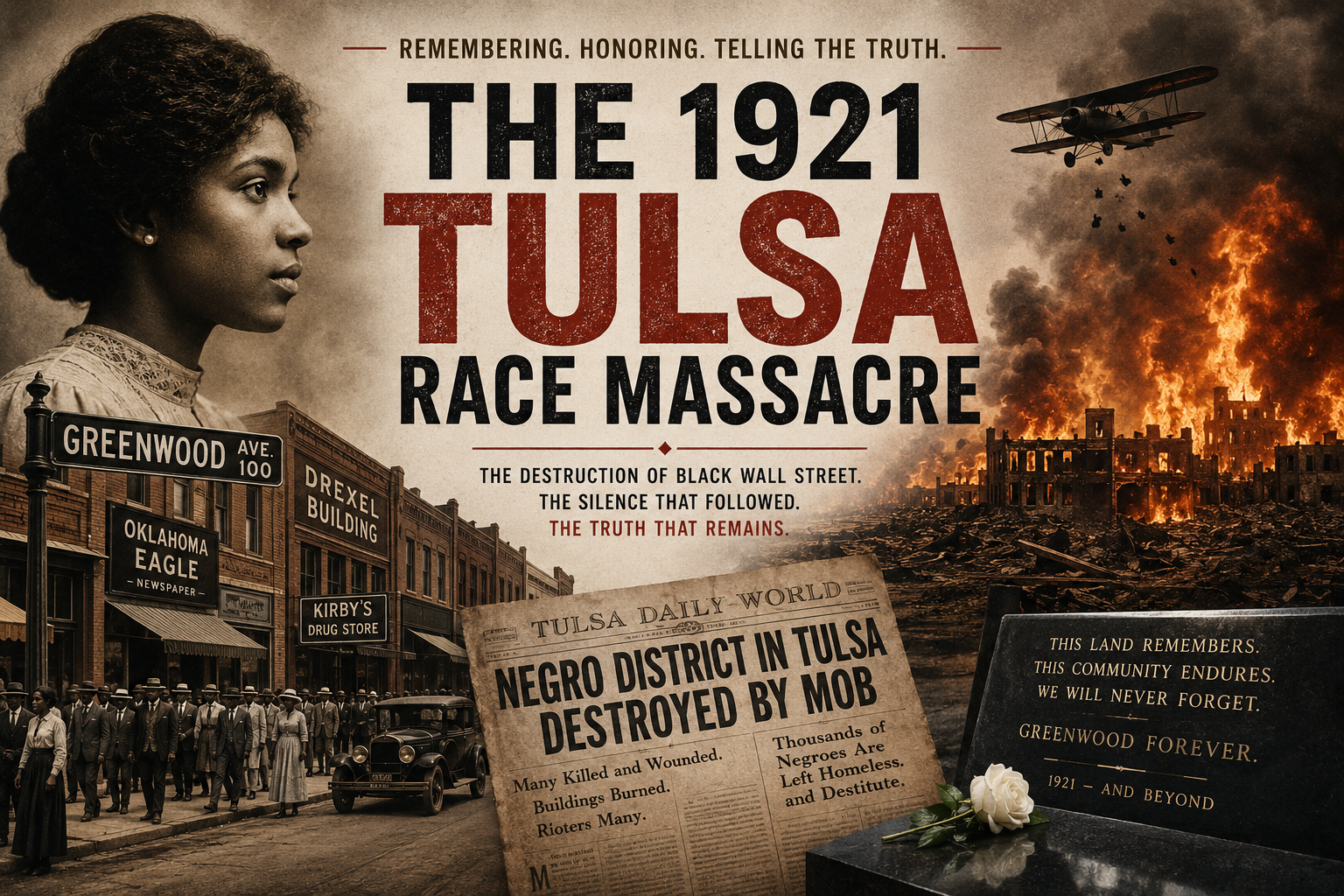
On May 31 and June 1, 1921, one of the worst incidents of racial violence in American history unfolded in Tulsa, Oklahoma. What began with an accusation in an elevator escalated into thirty-six hours of devastation that left a thriving Black community in ruins. For decades, this tragedy was deliberately suppressed, omitted from history books, and erased from public memory. Today, we remember not only what happened, but also what was lost and why the story of the 1921 Tulsa Race Massacre matters.

Greenwood District: The Black Wall Street
Before the violence, Tulsa’s Greenwood District was a beacon of Black prosperity and self-determination. In the early 20th century, while Jim Crow laws enforced rigid segregation throughout Oklahoma and the South, Greenwood’s residents built something extraordinary within those constraints.
The district earned its nickname “Black Wall Street” through sheer determination and ingenuity. Greenwood Avenue bustled with Black-owned businesses: luxury shops, restaurants, movie theaters, a hospital, schools, churches, and even a bus system. Doctors, lawyers, and entrepreneurs lived in elegant homes. The Oklahoma Eagle newspaper served the community. Banks financed Black enterprise when white institutions refused.

This prosperity emerged from both necessity and entrepreneurship. Segregation meant Black dollars circulated within the community multiple times before leaving, creating a multiplier effect that generated wealth. Oil discoveries near Tulsa had created opportunities, and many Black residents had prospered despite systematic exclusion from white economic institutions.
The success of Greenwood stood as both inspiration and provocation. It demonstrated what Black Americans could achieve with autonomy and opportunity, but it also bred resentment among some white Tulsans who viewed Black prosperity as a threat to racial hierarchy.
The Spark: An Accusation and an Arrest
The immediate trigger for the massacre came on May 30, 1921. Dick Rowland, a nineteen-year-old Black shoe shiner, entered the Drexel Building to use the segregated restroom on the top floor. He encountered Sarah Page, a seventeen-year-old white elevator operator, in the elevator. What exactly transpired remains unclear. Accounts suggest Rowland may have stumbled and grabbed Page’s arm to steady himself. Page screamed, Rowland fled, and by the next day, he was arrested on charges of assault.

The Tulsa Tribune published an inflammatory article with the headline “Nab Negro for Attacking Girl in Elevator.” However, the exact wording has been disputed, and the article itself has disappeared from archives. The story inflamed racial tensions that already simmered in Tulsa, a city where the Ku Klux Klan wielded significant influence.
By evening on May 31, a white mob had gathered at the courthouse where Rowland was held, with rumors swirling that he would be lynched. Lynching was a terrifyingly common extrajudicial murder tactic used to terrorize Black communities throughout the South and beyond. Between 1877 and 1950, Oklahoma recorded dozens of lynchings, and Tulsa had witnessed one just the previous year.
“To Have and to Hold”: Armed Resistance
When news of the mob reached Greenwood, a group of Black World War I veterans, still in their uniforms, made a fateful decision. They armed themselves and went to the courthouse to protect Rowland from lynching. This group included men who had fought for democracy abroad only to return home to Jim Crow segregation and racial violence. They offered their assistance to the authorities in protecting the prisoners.
The sheriff initially turned them away, assuring them he had the situation under control. The armed Black men returned to Greenwood, but as the white mob swelled to more than a thousand people, they came back to the courthouse around 10 p.m. Estimates suggest about seventy-five Black men, armed and determined, faced a crowd many times their size.
In the tense standoff, a white man approached a Black veteran and demanded that he surrender his weapon. The veteran refused. A struggle ensued, a shot rang out, and chaos erupted. The outnumbered Black defenders retreated toward Greenwood, and the white mob pursued them, now transformed into a rampaging force bent on invasion and destruction.
The 1921 Tulsa Race Massacre Begins
What happened next was not a riot—a term that suggests mutual combat or civil unrest. It was a massacre, a coordinated assault on an entire community. As Black residents defended their neighborhood through the night, white mobs gathered weapons, were deputized by city officials, and prepared for an organized attack.

By dawn on June 1, thousands of white Tulsans, many deputized and therefore acting with official sanctions, invaded Greenwood. They came armed with rifles and handguns. They systematically moved through the district, looting homes and businesses before setting them ablaze. Witnesses reported seeing white assailants use oil and turpentine to accelerate the fires.
Survivors recounted horrors: families gunned down in the streets, people shot while fleeing their burning homes, bodies left where they fell. Elderly residents and children were not spared. Many Black Tulsans who tried to defend their property were killed. Others fled into the countryside, hiding in fields and woods.
The most disturbing accounts describe how private planes, possibly from a local airfield, flew over Greenwood dropping incendiary devices and firing on residents from above. While historians have debated the extent of the aerial assault, multiple eyewitness testimonies describe bombs or explosive devices dropped from aircraft, making this potentially the first aerial bombing of an American city.
The Tulsa police and National Guard, rather than stopping the violence, participated in or facilitated it. Instead of protecting Black citizens, authorities arrested them en masse, marching thousands to internment centers at the Convention Hall and the fairgrounds. Many were held for days without charges. Meanwhile, their unguarded homes and businesses were ransacked and burned.
Thirty-Six Hours of Destruction
By the time the violence ended on the afternoon of June 1, Greenwood had been obliterated. The devastation was staggering: thirty-five city blocks burned to the ground, more than 1,250 homes destroyed, virtually every Black-owned business reduced to ashes: churches, schools, the hospital, the library—all gone. Survivors walked through smoking ruins where a thriving community had stood just hours before.
The official death toll was reported as thirty-six, but this number was almost certainly a dramatic undercount designed to minimize the atrocity. The true number of dead remains unknown. Estimates range from one hundred to three hundred people killed, with the vast majority being Black residents. Many bodies were buried in mass graves, thrown into the Arkansas River, or never accounted for. To this day, forensic archaeologists search for burial sites, attempting to give the victims proper accounting.
More than ten thousand Black Tulsans were left homeless. Many never returned. Those who stayed faced the daunting task of rebuilding without compensation, insurance payments, or government assistance. In fact, authorities blamed the victims, and some insurance companies invoked “riot clauses” to deny claims. The city even considered using the destroyed area for industrial development rather than allowing residents to rebuild.
The Great Forgetting
What followed the massacre was perhaps equally remarkable: a conspiracy of silence that lasted for decades. The Tulsa Race Massacre was systematically erased from history. It was not taught in Oklahoma schools. Newspapers that had covered it removed articles from archives or were instructed to destroy copies. Death certificates disappeared. Official records were sealed or destroyed. Survivors were pressured into silence, and many complied out of fear or trauma.
White Tulsans moved on as if nothing had happened. The burned district was sometimes referred to simply as “the riot” when it was mentioned at all, a euphemism that placed equal blame on attackers and victims. Greenwood’s prosperous history was forgotten, and with it, evidence of what Black Americans could achieve when given even a limited opportunity.
For generations, even many Tulsans, particularly white residents, knew nothing of the massacre. It was not until the 1970s and 1980s that historians and journalists began excavating the buried story. The first official state commission to investigate wasn’t established until 1997, seventy-six years after the event. The commission’s 2001 report recommended reparations for survivors and descendants, but meaningful compensation has never been provided.
Survivors and Memory
The survivors of the massacre carried their trauma for decades, often in silence. Many children who lived through the violence suffered from what we would now recognize as post-traumatic stress disorder, though that terminology didn’t exist at the time. Families lost everything—homes, businesses, photographs, documents, treasured possessions—and received nothing in return.
As survivors aged and began speaking publicly in the late 20th century, their testimonies provided crucial evidence of what had occurred. People like Olivia Hooker, who was six years old during the massacre and later became the first African American woman in the Coast Guard, shared memories of hiding under a table while white men ransacked her home. George Monroe lived to 103, spending his final years ensuring the story was told. Lessie Benningfield Randle, born in 1914, became one of the last living survivors, advocating for justice until her death in 2024.
These testimonies revealed not just the violence but also the vibrancy of what was lost—the community gatherings, the prosperous businesses, the sense of safety and pride that residents felt in Greenwood before it was destroyed. Their stories emphasized that the massacre was not just about physical destruction but about the theft of generational wealth, opportunity, and potential.
Why It Matters Today
The 1921 Tulsa Race Massacre remains relevant for several reasons. First, it represents a clear example of how racial violence has been used to destroy Black economic progress in America. Greenwood’s destruction demonstrates that the racial wealth gap we see today is not solely the product of individual choices or cultural factors but of deliberate violence and systematic denial of opportunity.
Second, the decades of suppression and silence around the massacre illustrate how historical narratives are constructed and controlled. The erasure of Tulsa from textbooks and public memory was not accidental but deliberate, an attempt to avoid uncomfortable truths about American racism.
Third, the 1921 Tulsa Race massacre and its aftermath represent a profound injustice that has never been remedied. Survivors and descendants received no compensation for destroyed property, lost lives, or stolen opportunities. This unaddressed harm continues to affect Black Tulsans today, who might have inherited family wealth and businesses had the massacre never occurred.
Recent years have seen renewed attention to the massacre, particularly around its centennial in 2021. The television series “Watchmen” brought the event to wider public consciousness. President Biden visited Tulsa to commemorate the anniversary. Efforts to locate mass graves have intensified, using ground-penetrating radar and forensic archaeology. Legal efforts to secure reparations continue, though they face significant obstacles.
Lessons and Legacy
The 1921 Tulsa Race Massacre teaches painful lessons about American history. It reveals how racial violence operated not just through lynching and intimidation but through organized, large-scale destruction of entire communities. Additionally, it shows how prosperity and self-determination by Black Americans could provoke murderous resentment from white supremacists. It demonstrates the complicity of governmental institutions—police, National Guard, city officials—in racial terror.
Perhaps most importantly, Tulsa reminds us that history is not inevitable or natural but shaped by human choices, both in the making of events and in how we remember or forget them. The decision to erase the massacre from memory was as deliberate as the decision to destroy Greenwood in the first place.
Today, the Greenwood Cultural Center and the John Hope Franklin Reconciliation Park stand in north Tulsa, dedicated to preserving this history. The Greenwood Rising museum, which opened in 2021, tells the story through immersive exhibits. These institutions ensure that future generations will know what happened, even if earlier generations were denied that knowledge.
The story of Black Wall Street also endures as an inspiration. Despite everything, some residents rebuilt. Greenwood recovered, though it never regained its pre-massacre prosperity and suffered further decline during urban renewal projects in the 1960s and 1970s. But the example of what was created—a flourishing Black community built against tremendous odds—remains a testament to resilience, entrepreneurship, and the human spirit.
Conclusion
The 1921 Tulsa Race Massacre stands as one of the darkest chapters in American history, a story of prosperity destroyed, lives stolen, and memory suppressed. For thirty-six hours in late May and early June, a white mob, aided by government officials, obliterated one of the most successful Black communities in the nation. They killed hundreds, destroyed thousands of homes and businesses, and erased a generation of Black wealth.
For decades afterward, a second violence was perpetrated: the violence of forgetting, of deliberate erasure, of denying victims even the dignity of having their story told. Only through the courage of survivors who spoke out and historians who listened has the truth been recovered.
We remember Tulsa not only to honor those who suffered and died but to confront honestly the role that racial violence has played in shaping American society. We recognize that the racial inequalities we see today have deep historical roots, that they were not inevitable but created through specific acts of violence and policy. And we remember it to ensure that such atrocities are never repeated and never again forgotten.
The lesson of Greenwood is ultimately one of both destruction and possibility. It shows us the worst of what humans can do to one another. But it also shows us, in the thriving community that existed before the massacre, what Black Americans could achieve when given even a fraction of opportunity. That vision—of what was and what might have been—continues to inspire and to challenge us today.
Leave a Reply