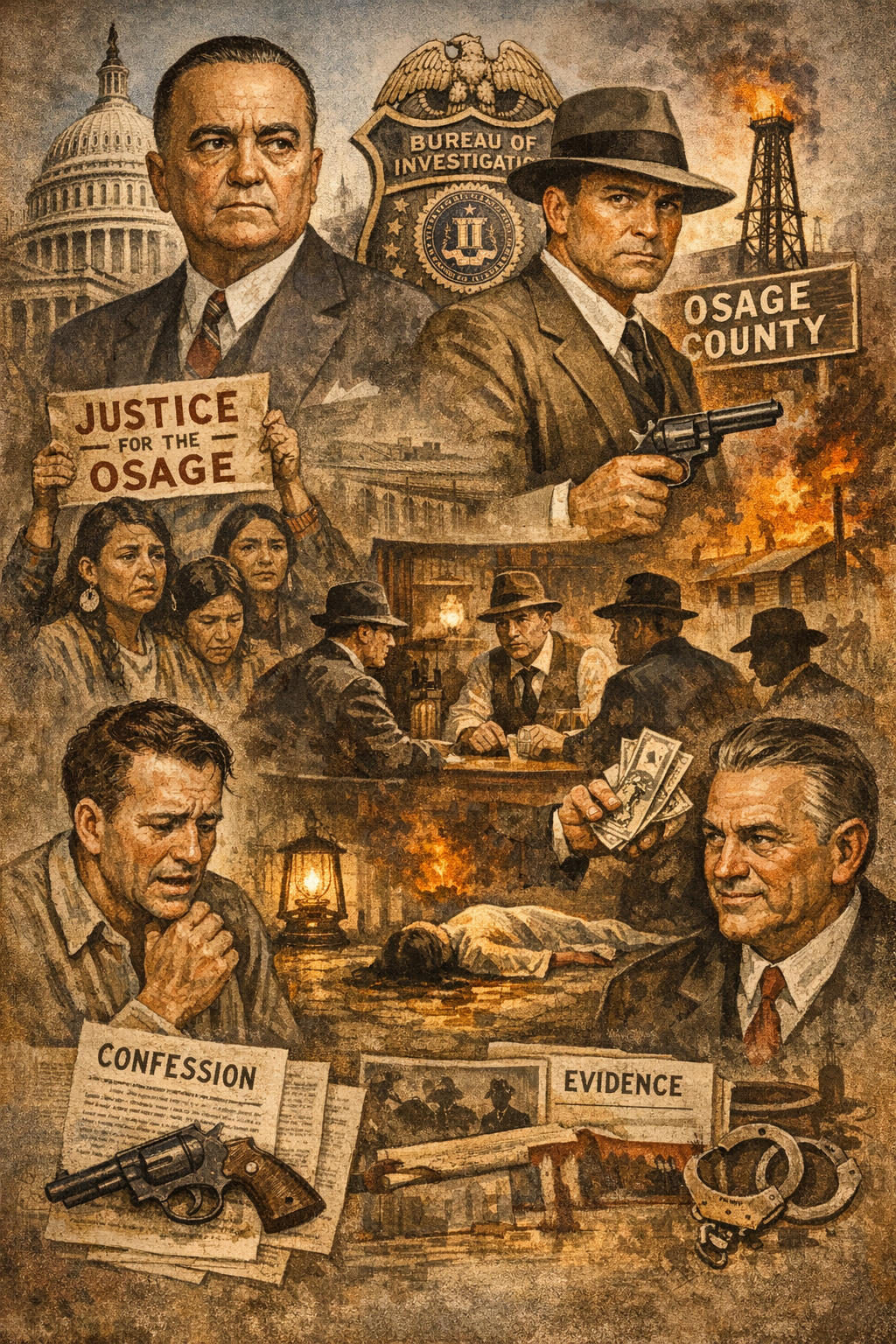
In the early 1920s, members of the Osage Nation in northeastern Oklahoma were among the wealthiest people per capita in the world. They drove expensive cars, built grand homes, and traveled internationally—a remarkable position for Native Americans during an era of widespread discrimination and marginalization. But this prosperity came with a terrible price. Between 1921 and 1926, dozens of Osage people were systematically murdered in what became known as the “Reign of Terror,” a calculated campaign of violence fueled by greed, enabled by racist laws, and largely ignored by local authorities.

The story of the Osage murders reveals a dark intersection of wealth, racial injustice, legal exploitation, and criminal conspiracy. It also marked a turning point in American law enforcement history, becoming one of the first major cases for what would eventually become the FBI. Today, thanks to David Grann’s 2017 book and Martin Scorsese’s 2023 film adaptation, both titled Killers of the Flower Moon, this long-overlooked chapter of American history has finally entered the public consciousness.
From Displacement to Unexpected Wealth
The Osage people’s journey to Oklahoma was shaped by centuries of forced displacement. Originally based in the Ohio Valley, they were pushed westward by European settlement and American expansion, eventually securing territory in what would become northern Oklahoma by the late 19th century. When their reservation lands were divided under the Osage Allotment Act of 1906, the tribe made a decision that would prove both fortunate and fateful: they kept communal mineral rights to the land beneath their individual allotments.
This decision transformed their fortunes when oil was discovered on their territory in the 1910s. Each Osage citizen received a “headright”—a share of the oil royalties that generated substantial income. The wealth was staggering. Osage families enjoyed a standard of living that rivaled the richest Americans, a sharp contrast to the poverty most Native Americans experienced at the time.

But this prosperity bred resentment among white settlers and business interests in surrounding communities. Prevailing racial attitudes assumed that Native Americans couldn’t manage wealth responsibly, and this prejudice soon found its way into law.
The Legal Framework for Murder
The wealth of the Osage didn’t just attract envy—it attracted a legal system designed to exploit them. Congress passed laws requiring many Osage people, particularly those with significant Osage ancestry, to prove their financial competency. Those deemed “incompetent” were assigned white guardians by county courts to manage their finances.
This guardianship system became a vehicle for systematic theft. White guardians collected substantial fees and often skimmed oil money with little oversight. The Osage were effectively stripped of control over their own wealth, declared legally incapable of managing the fortunes they’d rightfully earned.
Even more disturbing was another legal provision: headrights could be inherited by non-Osage people if a tribal member died without an Osage heir. This meant that outsiders could gain control of oil royalties simply by marrying into an Osage family—and then making sure their Osage relatives didn’t live long enough to inherit.
These laws didn’t directly cause the murders, but they created the perfect conditions for them.
A Pattern of Death
Starting around 1921, Osage people began dying under suspicious circumstances at an alarming rate. What at first looked like isolated incidents soon revealed a chilling pattern. Wealthy Osage individuals were being shot, poisoned, and killed in staged accidents.
One of the first high-profile victims was Anna Brown, whose decomposed body was discovered in a ravine in May 1921 with a bullet wound to the head. Authorities initially attributed her death to alcohol poisoning, ignoring clear evidence of murder.
The deaths continued. Lizzie Q. Kyle, mother of a prominent Osage woman named Mollie Burkhart, died from what was described as a “wasting illness”—almost certainly poison. Charles Whitehorn was shot to death. Henry Roan was found in his car with a gunshot wound. In March 1923, Rita and Bill Smith were killed when their house was destroyed by a bomb, an explosion that sent waves of fear through the entire Osage community.

Poison was a favored weapon because it could be disguised as natural illness. In an era before modern toxicology, proving foul play was nearly impossible. Bodies were buried without thorough investigation. Deaths were written off as accidents or natural causes. The pattern was obvious to the Osage community, but local law enforcement either couldn’t or wouldn’t see it.
Estimates suggest that more than 60 Osage people were murdered or disappeared during this period, though the true number may never be known. Many deaths were never properly investigated, and countless victims remain unnamed in historical records.
The Mastermind and His Plot
At the center of the conspiracy was William King Hale, a wealthy white rancher and businessman who wielded enormous power in Osage County. Known locally as the “King of the Osage Hills,” Hale had cultivated relationships with many Osage families, presenting himself as their friend and advocate while secretly plotting their destruction.
Hale’s scheme was diabolically simple. He arranged for his nephew, Ernest Burkhart, to marry Mollie Kyle, an Osage woman with substantial headrights. Under the inheritance laws, if Mollie’s relatives died, their headrights would pass to her—and through her, eventually to Ernest and Hale.

According to later investigations, Hale and his associates pressured Osage women to marry white men, then systematically murdered their relatives to consolidate headrights. They hired local criminals to carry out the killings and used poison, guns, and explosives to eliminate anyone standing between them and Osage oil wealth.
The conspiracy was breathtaking in its scope and cruelty. Hale wasn’t just stealing money—he was methodically draining both wealth and life from an entire community, all while maintaining his public image as a respected businessman and friend to the Osage.
When Local Justice Failed
Despite the mounting death toll, local authorities largely failed to act. Some officials were in on it. Others were intimidated by powerful perpetrators like Hale or simply unwilling to challenge wealthy white men on behalf of Native Americans. Corruption and racial prejudice meant that Osage pleas for help went nowhere.
The Osage Tribal Council repeatedly requested federal intervention. Finally, in 1925, the Bureau of Investigation—the predecessor to the modern FBI—took over the case. This became one of the agency’s first major homicide investigations and proved crucial to its development under director J. Edgar Hoover.
Hoover appointed Tom White, a former Texas Ranger, to lead the investigative team. White and his agents worked undercover, infiltrating local networks and gathering evidence in an environment where informants and investigators faced constant threats, bribery attempts, and violence.
The breakthrough came when Kelsie Morrison, one of the conspirators, confessed to his role in Anna Brown’s murder and implicated Hale and others. This confession provided the evidence needed to bring charges against the conspiracy’s architects.
Justice, Incomplete
The trials that followed were dramatic and messy. Ernest Burkhart eventually pleaded guilty and agreed to testify against his uncle, though he wavered in his loyalties throughout the proceedings. In the end, Hale and several accomplices, including John Ramsey, were convicted and sentenced to life in prison.
But justice remained frustratingly incomplete. Many murders were never solved or prosecuted. Some of those convicted were later paroled early, adding insult to injury for the Osage community. The broader culture of corruption and racism that had enabled the Reign of Terror was never fully addressed.
The Osage people had won convictions, but they hadn’t gotten their dead back or fully healed from years of terror.
A Legacy That Endures
The Osage murders left impacts that reached far beyond Oklahoma. The case helped legitimize and expand the FBI’s role in serious criminal investigations, demonstrating the need for federal authority when local law enforcement failed. To prevent similar abuses, Congress amended laws governing Osage headrights, making sure that non-Osage people couldn’t inherit them from tribal members with significant Osage ancestry.
For decades, though, the story remained largely unknown outside Oklahoma. It wasn’t until David Grann’s Killers of the Flower Moon was published in 2017 that the murders received widespread national attention. Grann’s meticulous research combined investigative journalism with narrative history, revealing not just the crimes themselves but the systemic corruption and racism that made them possible.
Martin Scorsese’s 2023 film adaptation brought the story to an even wider audience. Notable for its collaboration with the Osage Nation and use of the Osage language, the film sparked renewed discussion about this dark chapter in American history.
Remembering the Victims
Perhaps the most important thing about the Osage murders is remembering those who were lost. Anna Brown, one of the first high-profile victims, whose death helped spark the investigation. Lizzie Q. Kyle, whose “illness” masked murder. Henry Roan, whose killing provided crucial evidence to federal agents. Rita and Bill Smith, killed by a bomb meant to silence them. And countless others whose names have been largely lost to history.

These weren’t just victims of individual crimes—they were targets of a systematic campaign of terror driven by devastating prejudice and greed. Their deaths show how systemic injustice intertwines with economic incentives and how vulnerable communities suffer when legal systems fail to protect them.
Confronting Uncomfortable Truths
The Osage Nation murders represent more than a sensational historical crime story. They’re part of a broader pattern in American history: the exploitation of Indigenous peoples, the corruption of legal systems meant to protect the vulnerable, and the deadly consequences when prejudice meets greed.
While the convictions of Hale and his co-conspirators represented some accountability, they didn’t fully address the losses or fix the systemic failures that enabled the crimes. The impact extends into the present, reminding us why vigilance against injustice matters, why marginalized communities need real protection, and why we have to confront uncomfortable historical truths.
By exploring and remembering the Osage murders through books, films, scholarship, and conversation, we preserve the memory of those lost while reaffirming our commitment to justice. The story challenges us to recognize that wealth and privilege have never guaranteed safety for those society deems less than equal, and that the price of prosperity for vulnerable communities has too often been paid in blood.
The Osage Nation continues to work on documenting victims, recovering lost histories, and educating future generations. Their efforts ensure that the Reign of Terror won’t be forgotten and that the lessons it teaches about greed, racism, and justice will endure.
Leave a Reply