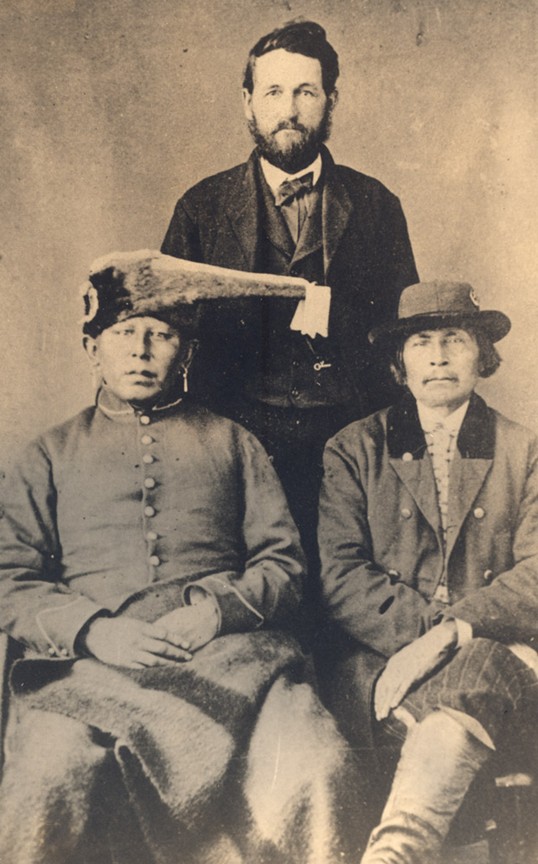
The summer heat of 1833 settled heavily over the grasslands near Rainy Mountain Creek in what would one day become southwestern Oklahoma. Kiowa bands had gathered there that June, not for war, but for sacred preparations for the Sun Dance, the ceremony that bound their people together across the vast plains. Then someone found an Osage arrow.

It might have been nothing. A lost shot from a hunting party, weeks or months old. But on the Southern Plains in 1833, an Osage arrow in your camp meant one thing: they knew where you were.
The Plains Before the Massacre
Long before Oklahoma became a state, before the Land Run, before oil derricks dotted the red dirt landscape, the Southern Plains belonged to nations who’d lived and died on this land for generations. The Kiowa were horse people, artists, and warriors whose lives moved in tandem with the buffalo herds and the seasons. Their most sacred possession wasn’t gold or land—it was the Tai-me medicine bundle, without which they couldn’t perform the Sun Dance.
To the east lived the Osage, equally formidable, equally proud. The two nations had circled each other for decades in a complicated dance of trade, competition, and periodic violence. It was the way of the plains: alliances shifted, territories overlapped, and survival often meant being the first to strike.
The Camp at Cutthroat Gap
After the Osage arrow spooked the gathering at Rainy Mountain Creek, the bands dispersed with plans to regroup later for the Sun Dance. Chief A’date—the whites would call him “Islandman”—led his band southwest into present-day Kiowa County, searching for better grazing and distance from potential danger.

They made camp, believing they were safe. Most of the warriors left to hunt buffalo or raid a Ute camp to the west, standard practice for young men proving themselves. What remained was typical of a summer encampment: women preparing hides, children playing between the lodges, elders telling stories, a handful of warriors keeping watch.
The Osage had been tracking them since the spring, as they moved west from the Three Forks region. They were patient. They waited for exactly this moment.
Morning, 1833
The attack came at dawn when the camp was most vulnerable. Osage warriors—some accounts say as many as a hundred—swept through the lodges with devastating efficiency. There was no time to organize a defense, no time to run. Women grabbed children and scattered toward the creek. A visiting Pawnee warrior, whose name wasn’t recorded, bought precious minutes for some families to escape before he fell.
When it ended, approximately 150 Kiowa lay dead. The camp was destroyed. And in an act that would sear itself into Kiowa memory for generations, Osage warriors had decapitated victims. They placed their heads in cooking pots—a message written in blood and terror.
The Osage took two captives: a boy named Thunder and a girl named White Weasel. They also took something more devastating than horses or scalps—they took the Tai-me medicine bundle, the sacred center of Kiowa spiritual life.
The Aftermath
When the Kiowa warriors returned to find what remained of their families, the site received its name: Cutthroat Gap. The place where throats were cut, where heads were severed, where a generation died in a single morning.
Chief A’date was removed from leadership. The logic was harsh but clear on the plains: he’d left the camp vulnerable, and his people had paid the price. Chief To-Hau-San took his place and would lead the Kiowa for decades.
But the deeper wound was spiritual. Without the Tai-me bundle, the Kiowa couldn’t perform the Sun Dance. For two years, that ceremony—the heartbeat of their nation—went silent.
Fragile Peace
In 1834, Colonel Henry Dodge led the First Dragoon Expedition through the region, part of the U.S. Army’s expanding presence on the Southern Plains. During negotiations facilitated by the expedition, White Weasel was returned to her people. Thunder had died in captivity.
Eventually, through intermediaries, the Osage agreed to return the Tai-me bundle—in exchange for a pony. That single horse brought back the Kiowa’s ability to pray in the way their ancestors had taught them.
Tensions between the Osage and Kiowa gradually cooled, though the memory of Cutthroat Gap never faded. Both nations had larger concerns on the horizon: the U.S. government was making promises about land and treaties, promises that would reshape the plains entirely.
The Site Today
If you drive Highway 54 near Cooperton in southwestern Oklahoma today, you’ll find a historical marker commemorating the massacre. The land looks peaceful now—rolling grassland under a big sky, the kind of country that seems to stretch forever. It’s hard to imagine the violence that unfolded here, the screams that echoed across these same hills in 1833.

The marker tells the basic facts, but it can’t convey what the Kiowa lost that morning. Not just 150 lives, but a sense of safety, a leader, and, temporarily, their ability to connect with the sacred. Cutthroat Gap became a place the Kiowa avoided, a wound in the landscape that never fully healed.
Why It Matters
The Cutthroat Gap Massacre doesn’t fit neatly into the typical narrative of Oklahoma history. There were no settlers involved, no cavalry charges, no treaties signed in its immediate aftermath. It was violence between Indigenous nations, the kind of history that complicates our understanding of the pre-statehood plains.
But that’s exactly why it matters. Oklahoma’s history didn’t begin with the Land Run in 1889 or even with the forced relocations of the 1830s. It began with nations like the Kiowa and Osage, whose own complex histories of alliance, conflict, ceremony, and survival played out on this land long before it was called Oklahoma.
The Kiowa oral tradition kept this story alive through generations. Historians like Wilbur Sturtevant Nye later recorded these accounts, ensuring that the massacre wouldn’t be lost to time. Today, Kiowa descendants still remember Cutthroat Gap—not as a moment of shame, but as a testament to their ancestors’ resilience.

They lost 150 people that day in 1833. They lost their sacred bundle. They lost a chief and a sense of invulnerability. But they didn’t lose themselves. The Sun Dance resumed. The Kiowa Nation continued. And the memory of that terrible morning near Cooperton became part of the larger story of survival on the Southern Plains.
That’s the real legacy of Cutthroat Gap: not just the violence of what happened, but the endurance of what came after.
Leave a Reply